Engineering experience across
Organizations represented in the selected work below.
DEVSFLOW / Connected Neurotechnology
DEVSFLOW builds BLE-connected mobile apps for research and clinical EEG, from multi-day patient recordings to multi-sensor field studies, with explicit handling for data integrity, crash recovery and the path from device to cloud.
Brain-sensing and biometric devices introduce specific requirements for transport, timing, data integrity, recovery, and validation.
BLE-connected biosignal applications commonly encounter:
Our approach coordinates mobile implementation with firmware behavior and the product's data requirements:
Organizations represented in the selected work below.
Signal modalities represented in the selected RE-AK and CLEIO engagements.
Electroencephalography: brain electrical activity
Electrodermal activity: skin conductance
Heart rate & heart rate variability
Geolocation: spatial context for field studies
Pulse oximetry: blood oxygen saturation
Camera recording synchronized with sensor data
A research kit built from an empty repository, and a clinical EEG companion app built inside the client's team.
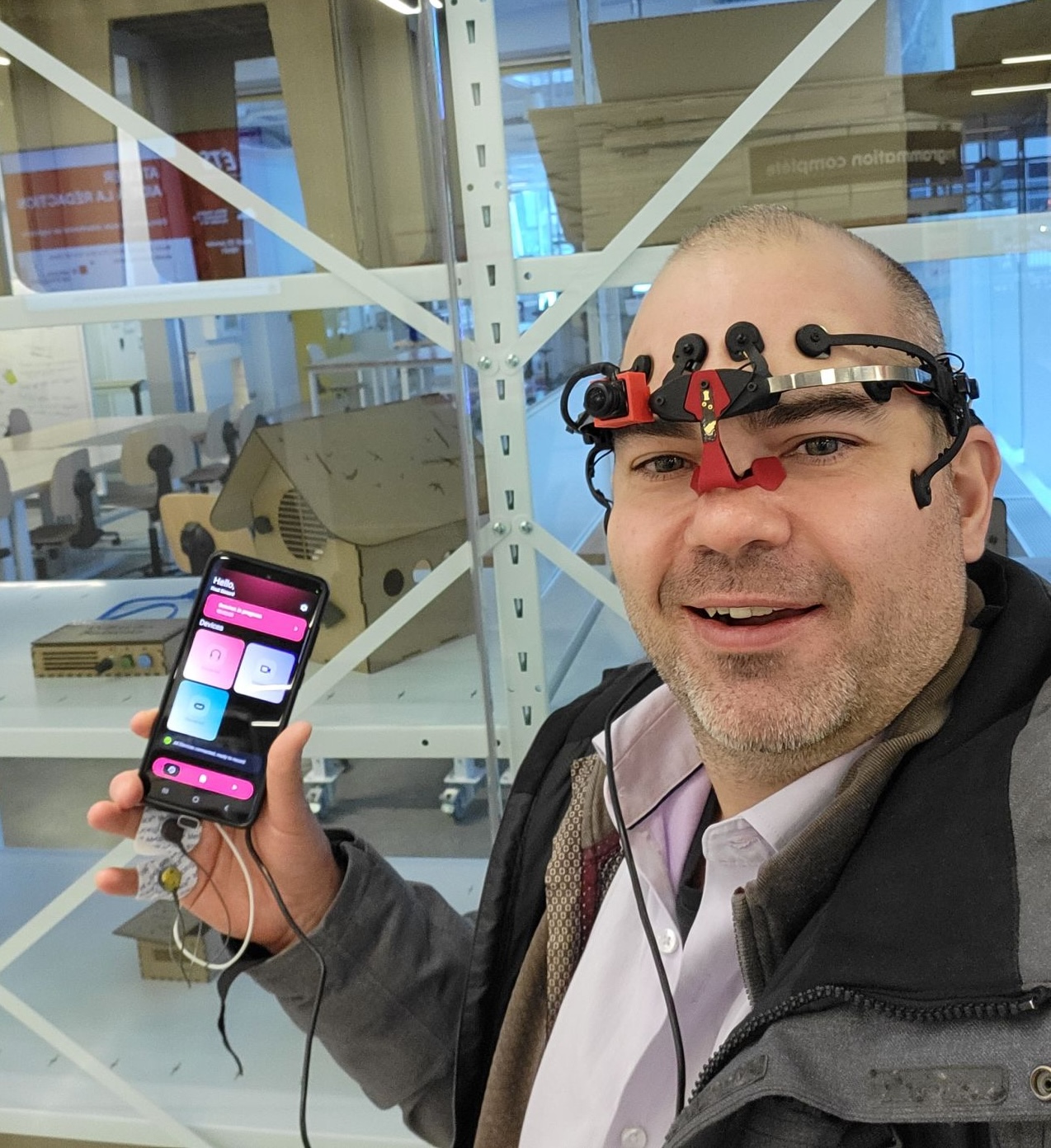
Vizia Mobile, built from an empty repository for a research kit combining EEG, EDA, HR/HRV, GPS, and point-of-view video. Researchers were recording real sessions within a month.
The scope covered concurrent sensor connections, screen-off recording, timing across streams and resumable upload.
A DEVSFLOW engineer inside CLEIO's Android team, on a companion app for a wearable EEG device used in multi-day clinical recordings.
Device work started weeks before hardware arrived, and no study has been lost to an app crash since the crash-safe lifecycle shipped.
Engineering capabilities for neurotechnology and biometric mobile applications.
Versioned GATT integration, negotiated MTU handling, measured connection behavior, serialized operations, and multi-peripheral state management.
Data-rate budgets, bounded receive pipelines, sequence verification, gap reporting, and validation on the actual peripheral and supported phones.
Product-specific signal processing and quality indicators can run locally when algorithms, performance limits, and scientific validation requirements are defined.
Recording without network connectivity, local persistence, background synchronization, and explicit detection and reporting of data gaps.
Session metadata, event markers, integrity summaries, and export formats such as EDF for clinical review software, selected with the researchers and downstream analysis pipeline.
A simulated device behind the same interface as the real one, with replayed captures and injected faults, so app work and testing can start before hardware is available.
Detection of missing ranges in a recording and recovery from the device's own storage over USB or Wi-Fi, fed back into the same pipeline.
Integrity-checked local files, chunked background upload with a shared retry policy, and status the operator can see while recording.
A physical-device and OS matrix derived from the supported market, with workarounds tied to reproduced traces and explicit regression tests.
Yes, and work does not have to wait for hardware. On a clinical EEG project we built a simulated amplifier behind the same interface as the real device, so the team could develop and test against realistic data, dropped packets and fault cases before hardware was available. A versioned protocol and a firmware engineering contact keep the simulator and the real device in step.
Our connected-device delivery so far is native Android, including BLE, background recording and lifecycle handling. iOS engineers are available for iOS or cross-platform products. A shared UI can also be viable when the team owns a well-defined native BLE and lifecycle layer. The choice depends on protocol complexity, diagnostics, background behavior, supported devices, and team ownership.
We define a physical-device matrix from the supported market, record phone and OS build with each failure, and validate the complete connection and data path under representative lifecycle and radio conditions. Workarounds are tied to reproduced behavior rather than chipset assumptions.
Yes. Mobile and firmware engineers should share a versioned protocol, traces, test fixtures, error semantics, and a change process so transport behavior is not inferred from either side alone.
We design packet sequence verification, local buffering, and session recovery around each product's recording protocol. Reliability is verified per device and workflow rather than claimed as one universal zero-loss number.
A credible estimate requires the protocol, firmware readiness, sensor count and rate, lifecycle requirements, target devices, validation plan, cloud scope, and any regulatory evidence. A short technical discovery should establish those inputs before a delivery schedule is set.
Technical writing on building mobile apps for EEG, BLE wearables, and biosignal devices.
BLE bandwidth, multi-sensor synchronization, background BLE on iOS, stream integrity, and SaMD.
BLEAligning EEG, EMG, EDA, and other modalities on a unified timeline.
StreamingSequence numbers, peripheral buffering, gap detection, recovery limits, and session integrity evidence.
DiagnosticsApplication timelines, HCI snoop logs, firmware traces, and privacy-conscious field diagnostics.
Send the BLE specification, signal characteristics, target platforms, and validation requirements. We can identify the principal mobile engineering risks and an appropriate discovery scope.